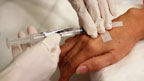
Allergy shots -- also called allergen immunotherapy -- can decrease a patient's sensitivity to allergens by injecting the allergens into the body regularly in gradually increasing amounts.
Typical costs:
For a patient not covered by health insurance, allergy shot cost consists of two parts: the vial of allergy serum -- which usually costs about $100 and contains about 10 shots -- and the administration of the injection. The cost for administration of the shot, including preparation of the allergy serum, is about $20 to $100 per visit, depending on whether a doctor or nurse administers the shots and whether more than one shot is administered. If shots are needed weekly, that's $1,560 to $3,900 per year, including the serum cost. In subsequent years, frequency might drop to twice a month, so the yearly cost would be about $720 to $1,800 per year, including the serum cost.
Allergy shots are often covered by health insurance. For patients covered by health insurance, typical out-of-pocket costs include a copay, usually between $10 and $25 per visit, or a percentage of the cost, usually between 10 and 40 percent. This can add up to between $500 and $1,300 -- with an average cost of $800 -- for the first year, which is the most expensive. For the next two to four years, yearly costs range from $170 to $290 per year. So, total out-of-pocket cost of the entire treatment can range from a little more than $800 on the low end to almost $2,500 on the high end.
Allergy shots can be used to treat a range of allergies including seasonal allergies, such as to ragweed and pollen; indoor allergies, such as to dust mites, mold and pet dander; and allergies to stings of insects, such as bees, wasps and hornets.
Allergy shots sometimes require years of treatments before immunity is achieved. Usually, the buildup phase, in which the dosage is gradually increased and shots are administered one to three times a week at the doctor's office, lasts three to seven months. Then, the maintenance phase, in which a consistent maintenance dose is administered once a month, can last three to five years.
Allergy shots usually start to work within four to six months, but can take a year or more.
Additional costs:
Some patients suffer a recurrence and need additional shots after the initial three- to five-year treatment. It is estimated at 75 to 85 percent of patient improve significantly.
Discounts:
Allergy drops, which are not yet FDA approved but are prescribed by some doctors as an off-label drug, are not covered by insurance but provide a less expensive and possibly more convenient alternative to allergy shots because they are self-administered daily, under the tongue. They cost about $12 per week or a little more than $600 per year.
Shopping for allergy shots:
Before considering allergy shots, it is important to get tested by a board-certified allergist to confirm the allergy. Board-certified allergists have completed a three-year residency in internal medicine or pediatrics, followed by two to three years of study in allergy and immunology. The American College of Allergy, Asthma and Immunology[1] offers an allergist locator by zip code. Or call their hotline, 1-800-842-7777 for a referral.
After testing, talk to your allergist about whether you are a good candidate for allergy shots. Allergy shots do not work for food allergies or people with chronic hives, and they are not recommended for people with severe uncontrolled asthma or heart problems, especially those taking beta blockers. And allergy shots should not be started during pregnancy, but may continue during pregnancy if started before conception.
Allergy shots are considered fairly low risk. Side effects can include redness, swelling and itching at the injection site or, less commonly, a systemic reaction that can include sneezing, wheezing and hives. Most reactions occur within 30 minutes and can be treated by the allergist. In very rare cases, deaths have occurred.
For patients wishing to see faster results, a more intensive allergy shot regimen might be available.
Material on this page is for informational purposes only and should not be construed as medical advice. Always consult your physician or pharmacist regarding medications or medical procedures.
7 Lesser-Known Discounts for the 50+ Crowd As they age, members of the Baby Boomer generation don't like to admit that they're senior citizens, but they love getting discounts. It's kind of a quandary, because some of the best deals available are reduced prices for older folks. || Posted October 21 2013
7 Ways to Stretch Your Reduced Food Budget End of the year budgets are tight for everyone, especially in this economy.It's especially hard for the millions of Americans who depend on government programs like food stamps to help make ends meet. || Posted November 11 2013
Kaiser set up the allergy shots as “injections” in their system so I don’t have to pay a co-pay when I go for my weekly shot (administered by a nurse). I did have to pay the co-pay for the initial consultation with the allergist and the testing but it’s been free ever since. So definitely worth it for other Kaiser members.
My cost is $4,500 to create my serem (this is my deductible). After this I I will meet my deductible and pay 10% of injections and insurance pays 90%. Injection is $15 each and will need 8 a month for year. Next year I will have to pay out of pocket until I meet deductible.
Posted by: Dorothy J Smedberg in Hollidaysburg, PA.
Posted: April 30th, 2019 06:04PM
Medical Center: Central Altoona Allergy, PA
Insurance: BCBS Minnesota
My initial entry exam and tests were 457$ and that made me hit my 1000$ out of pocket deductible. I had to have 9 weekly injections after that each one is about 280$ insurance leaves about 40-60$ per shot. It's really expensive and after this I am supposed to have monthly shots at my GP. I think my health insurance is pretty good (monthly payment ~180$ 1000 deductible 2500$ out of pocket Max) but this is still putting a huge hole in my finances.
I had a goof up with my insurance and wasn't covered for a couple months. The two vials cost $700 and last about 3 months. Injections are $45 every time. I've been on them for almost a year. I did the math and for a year of shots it is around $5000 for the first year. I can't pay my entire bill from when I didn't have insurance. The office manager refuses to allow me to continue to get the shots until the bill is completely paid off. The shots are a time sensitive thing, and I just started a new vial. So I guess I'm not going to be able to get them again without starting over. Very upset. Before I started the shots I had chronic bronchitis because of my dust allergies. Not looking forward to it
For treatment with 1 vial (2 allergies). Year 1 BCBS with high deductible Dr visit and test: $420 Antigen: $600 Shot: 44 at $12.60= $554 2 Dr visits follow up: $210 Year 2 United Serum: $880 8 shots at $12.35=$99 9 shots at $20.20= $182 Shots total $280 Follow up with dr: $57 In addition, plan for another year at $1200, total $5300 for 4 years. Clinic said that the cost of serum is the same after first year even though I get 12 shots instead of 48.
Why even consider allergy shots when there are treatments like NAET (Nambudripad Allergy Elimination Technique) You get a series of treatments from an acupuncturist certified in the technique and in most cases, the allergies are gone forever. It may have side-benefits as well, like improving other areas of your health. (No, I'm not an acupuncturist, just someone who was helped by the technique.)
I would like to know where the person above that had no co-pay purchased their insurance from. I also have Blue Cross Blue Shield, at the gold-level plan. They informed me that my co-pay would be $30 per injection, and I need 28 injections. This is close to $900 for the full course, which I can not afford and must suffer. I have found multiple programs that assist with paying for pain medication, asthma, arthritis, even kidney stones, but NONE that will assist with allergy shots no matter how debilitating your condition.
I have had the same problem with the high expense of the "nurse" giving the shot. Vaccine probably only covered once and the Dr will not let go of it, not even to give it to my primary Dr.and not me to give my own shots. I am an RN and very capable of giving my own shots, and have had allergy shots before with the Dr giving me the serum to give my own shots. When I called United Health Care they did not know what I was talking about. I simply want to know if they can help me get the serum from the Dr or pay for being re-tested and/or help pay for a new batch of serum. I now am worse and back on medication without the allergy shots and no one knows what to do.
The VA wants to charge me 50.00 for a specialty clinic visit every time I go in for a shot, even though I will never see the doctor. The VA says this is their policy and they are not changing!
My previous insurance company was Blue Cross Blue Shield, and they charged me no co-pay for my shots. When we switched carriers at the beginning of the year, I thought this would continue, but it didn't. I now had to pay $35 per visit, but of course, because UHC were slow on getting everything going, it took them 3 months before we were in the system. 12x35 was a lot of money to hit me. Anyway, I started taking the serum to my general doctor, figuring the $20 to see his nurse would be cheaper. Lo and behold, they don't charge copays for shots! So, I've been doing that the past 5 months. Shop around!
This is such a rip off. $35.00 every wk and the nurse gives me the shot. I stopped couldn't afford. Now I have pneuommia. Missed alot of work and qualtiy of life not good. What is a person to do that is getting ready to go on medicare?
My vials/serum are take home..meaning I give myself shots every other day until it is time to cut down to twice a week.rnrnUMR said I would be covered 100% but as it turns out they are only covering 70%. It all depends on the wording (shots, injections, or serum) & the cpt code used. rnrnEven though it is insanely expensive, my shots are 100% customized to benefit me. It's not some generic shot like a lot of clinics. I've completed year one & I only missed 1-2 days for being ill compared to 6 the year before. Also, my year 2 test results speaks for itself. I only had 3 allergens pop up, whereas, before it was around 20ish.
Medical Center: Environmental Health Center - Dallas
Insurance: United Health Care
Firstly United Health Care covers my antigen shots 100%, which is amazing.
More importantly, the allergy shots I take are not a one-size-fits-all shot that most allergy clinics give that you have to take forever. The Environmental Health Center tests one item at a time and gets a specific you-specific dose that "shuts off your reaction to that item." Then, that is the dose you get in your shots.
That being said, I think the cost of antigens without insurance coverage is like $28 per 20doses for most items (there are some that require more intense testing and cost more, but not many). I pay this all out of pocket and insurance reimburses me.
Best place for the money considering their allergy shot regimen gets rid of your allergies and in a way that doesn't make you sick during the process. Plus the average person takes the allergy shots for 18 months and then is done.
Posted by: disbeliver in Whiting ,NJ in whiting, NJ.
Posted: February 1st, 2011 10:02AM
Medical Center: doctors office
Insurance: medicare
after taking allergy shots for 50 years I want to go from every 28 days to 56 days but was told the doc has to give them eveyr 28 days? I have trouble beliving this.
When I first started getting shots in 2007, Blue Cross's (CA) very small print said that the maximum yearly benefit for vaccines was $800, and they categorized allergy shots as a vaccine. Well, after pretty much maxing the benefit out with allergy shots, I ended up having to pay over $2,000 the first year for shots, usually $85 per shot ($100 minus a $15 adjustment). But that's 3 times a week at first (and after several months, you slowly work your way down to once a month). The allergy shots have helped with my allergies -- I needed them, so I had to pay, but if you are planning to get allergy shots "some day" and are flexible with time, I suggest you read the small print on your insurance policy, and if needed, consider even switching policies if you can to cover allergy shots, because it's a lot of dough.
CostHelper is based in Silicon Valley and provides consumers with unbiased price information about thousands of goods and services. Our writers are experienced journalists who adhere to our strict editorial ethics policy.
CostHelper Community
UTI urgent care visit Paid: 147.00 Visit was $135. Antibiotics was $12. Waiting for four hours in the waiting room and the visit was quick... [more]
Spanish Medical Interpreter Paid: 150.00 I worked with SynShyne Services out of Monroe, NC. They were so worth the price! Professional, friendly, accurate, great attitude and always on time. I recieved an itemized report after every contact and a user friendly invoice weekly... [more]
Skin prick allergy test Paid: 573.00 Took my 9 yr. old in after an allergic reaction to eggs. Several panels for nuts, fish & top 8 allergens. Sure enough, egg came up. Got a script for epinephrine and left... [more]






 Post
Post